
Your drain lines carry every drop of wastewater out of your home, and when they start to fail, they rarely give you one big, obvious warning. Drain line cleaning warning signs in Cowpens tend to show up gradually, a sink that takes a few extra seconds to empty, a faint smell near a floor drain, a toilet that gurgles when the washing machine runs. Most homeowners dismiss these signals for weeks or months, and by the time the problem becomes impossible to ignore, it has usually grown far more expensive to fix.
Cowpens sits in the eastern part of Spartanburg County, where homes range from well-established properties built in the mid-twentieth century to newer construction along the town’s expanding edges.
The Upstate Piedmont geology underneath the area, with its clay-heavy soils and mature tree canopies, creates conditions that accelerate drain and sewer line problems in ways that homeowners in other regions may never deal with. Understanding what your drains are trying to tell you is the first step toward keeping a small issue from becoming a major one.
This article breaks down the specific warning signs that mean your drain lines need professional attention, explains why Cowpens homes face particular risks, and walks through what happens when those signs go unaddressed. If you have been wondering whether that slow drain or odd sound is something to worry about, the answer is almost always yes.
In this article, you will learn about:
- The early warning signs that your drain lines are starting to fail
- Why Cowpens homes are especially vulnerable to drain and sewer line problems
- What happens inside your pipes when you ignore a slow drain
- How grease, roots, and everyday habits cause the most common blockages
- When to call a professional and what drain line cleaning actually involves
Keep reading to catch the warning signs early enough to avoid the kind of backup that disrupts your entire household.
The early warning signs most Cowpens homeowners miss
Drain problems almost never start as emergencies. They start as small, easy-to-dismiss changes in how your plumbing behaves. The difference between a minor cleaning and a major repair often comes down to how quickly you recognize those changes and act on them.
The challenge is that most people do not pay close attention to their drains. Water goes down, life moves on. But drains that are starting to clog behave differently in specific, predictable ways, and learning to read those behaviors saves you money and prevents the worst-case scenarios.
Slow drains are not just an inconvenience
A drain that empties slower than it used to is the single most common early sign of a developing blockage. It does not matter whether it is a kitchen sink, a bathroom sink, a shower or tub, or a floor drain. Slow drainage means something is restricting the flow inside the pipe, and that restriction is getting worse every time you use the fixture.
What makes slow drains deceptive is that the change happens gradually. You might not notice the difference from one week to the next because the decline is incremental. But compare how your drain performs today to how it performed six months ago, and the difference is often significant.
A few things to watch for:
- Water pooling around your feet in the shower instead of draining as fast as it flows in
- A kitchen sink that holds standing water for several seconds after you pull the stopper
- A bathroom sink that takes noticeably longer to empty than it did when you moved in
- Bubbles rising through standing water as a drain slowly empties, which indicates trapped air behind a partial blockage
If you notice slow drainage at a single fixture, the blockage is most likely in the branch line that serves that fixture. If multiple fixtures are draining slowly, especially fixtures on different floors or different parts of the house, the problem is further down the system, possibly in the main drain line itself.
Gurgling sounds are your pipes talking
Gurgling or bubbling sounds from a drain, a toilet, or a vent stack are not normal plumbing noise. They are the sound of air being displaced through water because the normal airflow path inside the drain system is partially blocked.
Your plumbing system relies on vents to equalize air pressure as water flows through the pipes. When a blockage disrupts that airflow, trapped air forces its way through the water sitting in traps and fixtures, producing the gurgling sound you hear. The louder and more frequent the gurgling, the more significant the restriction.
Pay attention to when the gurgling occurs. If your toilet gurgles when you flush a different toilet, when you run the washing machine, or when you drain the bathtub, it means the blockage is affecting the shared drainage path that serves multiple fixtures. That is a main line problem, not a single-fixture clog.
Gurgling that happens on its own, without any water running, can indicate that a vent is blocked by debris, animal nesting material, or ice in winter. A blocked vent creates negative pressure inside the drain system, which can pull water out of traps and allow sewer gas to enter the home.
Sewage odor inside the home
If you smell sewage inside your house, something has gone wrong with the seal between your living space and the drain system. The most common causes are a dried-out trap, a cracked or broken drain line, or a blockage that has forced waste material to back up close enough to an opening that the odor escapes.
Every drain fixture in your home has a P-trap, which is the curved section of pipe that holds a small amount of water to block sewer gas from rising into the room. If a fixture goes unused for a long period, the water in the trap can evaporate, breaking that seal. This is common in guest bathrooms, basement floor drains, and laundry standpipes. Running water through an unused drain for a few seconds restores the seal.
But if the smell persists even when traps are full, the problem is deeper. A partial blockage in a drain line can create a buildup of waste material that produces odor, and a crack or separation in an underground sewer lateral can release sewer gas into crawl spaces or the soil around your foundation. Either situation calls for professional leak detection and inspection, not just a pour-and-hope approach.
Water backing up where it should not
This is the warning sign that no one ignores, but by the time it happens, the problem is usually well advanced. When water from one fixture backs up into another, it means wastewater has nowhere to go. The blockage has reached a point where the system cannot move waste forward, so it pushes backward into the lowest available drain.
Common scenarios include:
- Flushing a toilet and seeing water rise in a nearby shower or tub
- Running the washing machine and finding water pooling around a basement floor drain
- Using the kitchen sink and hearing or seeing water in a first-floor bathroom
Any time two or more fixtures are interacting this way, the clog is in the main drain line or the sewer lateral, not in an individual branch. This is not a situation for a plunger or a bottle of chemical drain cleaner. It requires professional cleaning equipment and, in many cases, a camera inspection to determine what is causing the blockage before any permanent fix can be recommended.
Why Cowpens homes face specific drain and sewer risks
Every region has its own set of conditions that affect underground plumbing, and Cowpens is no exception. The combination of the Upstate’s geology, the age of existing housing stock, and the mature landscaping throughout the town’s established neighborhoods creates a particular set of challenges for drain and sewer lines.
Understanding these local factors helps you anticipate problems before they develop and make smarter decisions about maintenance and prevention.
The Piedmont clay factor
Cowpens lies in the Carolina Piedmont, a geological region characterized by heavy clay soils underlain by ancient metamorphic and igneous rock formations. Clay soil behaves differently from sandy or loamy soil in ways that directly affect buried pipes.
Clay expands when it absorbs moisture and contracts as it dries out. This seasonal movement puts continuous mechanical stress on underground pipe joints, particularly in older homes where clay tile or cast iron drain lines were the standard material. Over years of expansion and contraction cycles, joints separate, connections shift, and small cracks develop in pipe walls. Each of those openings becomes an entry point for roots, soil, and groundwater infiltration.
The water quality in the Spartanburg area also plays a role. The Piedmont bedrock contributes mineral content to the local water supply, and those minerals deposit inside drain lines over time. Combined with grease, soap residue, and organic material, mineral scale narrows the effective diameter of a pipe and makes partial blockages more likely.
Older pipes in an established community
Cowpens was chartered in 1880 and incorporated in 1900. While the town has seen newer construction, a significant portion of its housing stock dates from the mid-twentieth century, a period when clay tile and cast iron were the standard materials for sewer laterals and drain lines.
Clay tile pipes were installed in short segments with mortar joints, and those joints are the weakest point in the system. After decades of soil movement, root pressure, and gradual deterioration of the mortar, the joints separate enough to let roots in and let wastewater out. Cast iron drain lines corrode from the inside over time, developing rough surfaces that catch debris and accelerate buildup that leads to blockages.
If your Cowpens home was built before the 1980s and has never had its sewer lateral inspected or replaced, there is a reasonable chance that the original pipe material is approaching or past its expected service life. That does not necessarily mean it needs to be replaced tomorrow, but it does mean that periodic inspection and proactive cleaning are especially important.
Tree roots are the most persistent threat
Cowpens has mature trees throughout its neighborhoods, and those trees have root systems that extend far beyond what is visible above ground. According to the U.S. Forest Service, tree roots are responsible for more than 50 percent of all sewer blockages, and the costs associated with root removal and the pipe damage roots cause are substantial.
Roots are drawn to the moisture and nutrients inside sewer lines. They do not break into intact pipes on their own. Instead, they exploit existing cracks, separated joints, and deteriorated seals to enter the pipe. Once inside, they grow rapidly in the nutrient-rich environment, catching debris and creating progressively worse blockages.
In the Upstate, oaks, sweetgums, and other deep-rooted species are common, and the Piedmont clay soil forces roots to travel aggressively in search of moisture. A sewer line with even a minor joint separation acts as a reliable water source that roots will find and exploit. The result is a cycle where root growth causes blockages, the blockages cause backups, and the root mass continues to expand until the pipe is either cleaned professionally or replaced entirely.
Properties with large trees within 20 to 30 feet of the sewer lateral should treat periodic camera inspection as a routine part of home maintenance, not something to schedule only after a backup has already occurred.
What actually happens inside your pipes when you wait too long
Most homeowners understandably avoid thinking about what goes on inside their drain lines. But understanding the progression from a partial blockage to a full backup helps explain why early intervention matters so much and why the cost of waiting is always higher than the cost of acting.
From slow drain to total blockage
A partial blockage does not sit still. It grows. The narrowed section of pipe catches more material with every use of the fixture, and the accumulation accelerates because the flow velocity through the restricted area drops as the opening narrows.
Think of it this way. A fully open four-inch drain line moves wastewater efficiently enough that most solids stay suspended and flow through. A line that is 50 percent blocked moves water at a fraction of the velocity, which means solids that would have passed through a clean pipe now settle and stick. Grease, soap scum, hair, food particles, and mineral deposits all accumulate faster in a partially blocked line than in a clean one.
This is why slow drains get worse over time, never better. The physics of restricted flow guarantee that a partial blockage will eventually become a complete one unless it is cleared.
Sewage backup is a health hazard, not just a mess
When a drain line blockage becomes complete, wastewater backs up into the home through the lowest available drain. According to the U.S. Environmental Protection Agency, raw sewage carries bacteria, viruses, parasitic organisms, and fungi that can cause illnesses ranging from mild gastrointestinal distress to serious conditions including hepatitis and dysentery.
A sewage backup in your home exposes floors, walls, baseboards, and any absorbent material to contaminated water. Cleanup requires more than mopping. It requires proper sanitization of every affected surface, removal of contaminated porous materials, and thorough drying to prevent secondary problems.
The EPA estimates that at least 23,000 to 75,000 sanitary sewer overflows occur annually across the United States, not counting sewage backups into individual buildings. Many of those events trace back to blockages that developed over time and could have been prevented with routine maintenance.
The financial math of waiting versus acting
Routine drain line cleaning is one of the least expensive professional plumbing services a homeowner can schedule. A camera inspection of a sewer lateral is similarly modest in cost relative to the value of the information it provides.
Compare that to the cost of emergency service after a full backup, which includes the cleaning itself plus potential water damage restoration, replacement of contaminated flooring or drywall, sanitization, and the disruption to your household during the process. The numbers are not close. Preventive cleaning costs a fraction of emergency remediation, every time.
There is also the question of pipe damage. A drain line that is cleaned regularly stays in serviceable condition longer because the cleaning removes the material that accelerates corrosion and joint deterioration. A line that is never cleaned deteriorates faster, and the eventual sewer line repair or replacement becomes more extensive and more expensive than it would have been with consistent maintenance.
How grease, roots, and everyday habits cause the worst blockages
Most drain line problems in Cowpens homes come from three sources, either individually or in combination. Knowing what drives blockages helps you prevent them, and it helps you understand what a professional is looking for during an inspection.
Grease is the quiet destroyer
Cooking grease and oil are liquid when they go down the kitchen drain, but they do not stay liquid for long. As grease cools inside the drain line, it solidifies on the pipe walls, building up a layer that narrows the pipe with every use.
The problem compounds because grease acts as a trap for everything else that flows through the line. Food particles, soap residue, and even mineral deposits from the local water supply stick to the grease layer, creating a dense buildup that professional plumbers sometimes describe as looking like hardened concrete when they camera-inspect a line that has never been cleaned.
Preventing grease buildup starts with keeping it out of the drain entirely:
- Never pour cooking oil, bacon grease, butter, or meat drippings down the kitchen sink. Let grease cool in a container and dispose of it in the trash.
- Scrape plates thoroughly before washing them, even if you have a garbage disposal. Disposals grind food into smaller pieces, but they do not prevent those pieces from contributing to downstream buildup.
- Run hot water through the kitchen drain for 30 seconds after each use to help flush residual grease through the line before it cools and hardens.
Root intrusion is a long-term battle
As described earlier, tree roots are the single largest cause of sewer line blockages across the country. In Cowpens, the combination of Piedmont clay soil, mature landscaping, and aging pipe materials makes root intrusion one of the most common reasons homeowners call for drain service.
The key thing to understand about root intrusion is that it is not a one-time fix. Cutting or jetting roots out of a pipe solves the immediate blockage, but unless the entry point is sealed or the pipe is replaced, the roots will return. Root growth accelerates in spring and summer when trees are actively taking up water, which is why many Cowpens homeowners experience their worst drain problems during the warmer months.
If a camera inspection reveals root intrusion in your sewer lateral, your plumber can discuss the options based on the severity and the overall condition of the pipe. Minor intrusion in an otherwise sound pipe might be managed with periodic cleaning. Significant intrusion in a pipe that is already cracked or deteriorating may call for repair or replacement to provide a lasting solution.
The things you flush matter more than you think
After grease and roots, the third most common cause of drain blockages is the material that homeowners put into the drain system every day. Products marketed as “flushable,” including wipes, feminine hygiene products, and thick paper towels, do not break down in water the way toilet paper does. They catch on rough pipe surfaces, collect at joints, and build up behind any partial restriction in the line.
According to the EPA, inappropriate materials sent into sewers, including fats, oils, grease, and household products such as baby wipes and facial wipes, even those labeled “flushable,” are a leading contributor to sewer system blockages.
The rule is simple. The only things that should go down a drain are water, human waste, and toilet paper. Everything else goes in the trash, regardless of what the packaging says.
- Do not flush wipes of any kind, not baby wipes, not cleaning wipes, not makeup removal wipes
- Do not flush feminine hygiene products, cotton swabs, or dental floss
- Do not use the toilet as a disposal for excess food, pet waste in bags, or anything solid that is not toilet paper
- Keep a small wastebasket next to every toilet in your home so there is always a convenient alternative to flushing
When to call a professional and what drain line cleaning involves
Some drain issues can be addressed with a plunger and a little patience. Others require equipment and expertise that go beyond what any homeowner should attempt. Knowing where that line falls helps you respond appropriately and avoid making a problem worse.
What you can handle at home
A single slow drain at one fixture is often a branch-line issue you can address yourself. A plunger, a drain strainer cleanup, or a manual drain snake from a hardware store can clear minor clogs in sink and tub drains.
A few guidelines keep DIY drain work safe and effective:
- Avoid chemical drain cleaners entirely. They are corrosive to pipe materials, especially cast iron and older PVC, and they rarely resolve anything beyond the most superficial clogs. The chemicals can also splash back if the drain does not clear, creating a safety hazard.
- A hand-cranked drain snake is useful for clearing hair and soap buildup in bathroom drains. Feed it slowly and let the tool do the work rather than forcing it aggressively into a blockage you cannot see.
- If a plunger or hand snake does not resolve the issue within a few minutes, stop and call a professional. Forcing tools into a drain line without knowing what is causing the blockage can damage the pipe or push the clog deeper into the system.
The signs that it is time to call a plumber
Schedule professional drain service when you notice any of the following:
- Multiple fixtures draining slowly or backing up at the same time
- Recurring clogs in the same drain despite repeated clearing
- Gurgling sounds coming from drains or toilets when other fixtures are in use
- Sewage odor that persists after confirming all traps are full
- Any visible sewage or wastewater backing up into the home
- Wet spots, sunken areas, or unusually green patches in the yard along the path of the sewer lateral
- Water stains or dampness in the basement or crawl space near drain line connections
These symptoms point to problems that require professional equipment to diagnose and resolve. Attempting to clear a main line blockage or a root intrusion without the right tools risks making the situation worse and potentially damaging the pipe.
What professional drain line cleaning looks like
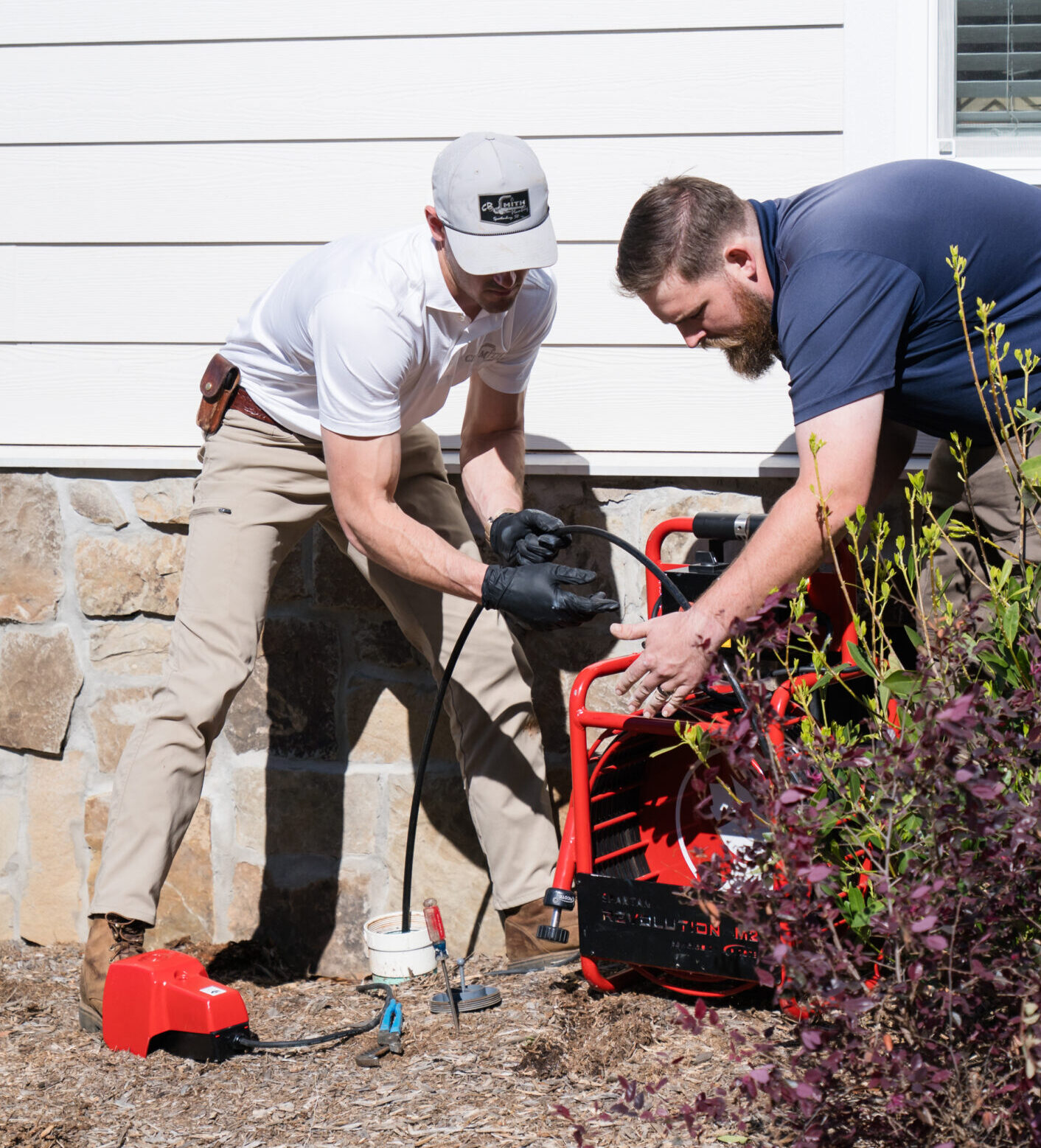
When a licensed plumber responds to a drain line issue, the process typically starts with an assessment to determine where the blockage is and what is causing it. In many cases, this includes a camera inspection, where a small, waterproof camera is fed into the drain line to provide real-time video of the interior condition.
The camera shows the plumber exactly what is happening: where the blockage is located, whether it is caused by grease, roots, debris, or a structural problem with the pipe, and how much of the line is affected. This information determines the most effective cleaning method and identifies any underlying issues that need to be addressed.
Professional cleaning methods include:
- Mechanical cable cleaning, also called snaking, uses a rotating cable with a cutting head to break through blockages and clear accumulated material. This is effective for most household clogs and moderate buildup.
- Hydro jetting uses high-pressure water to scour the entire interior surface of the pipe, removing grease, scale, roots, and debris. It is more thorough than mechanical cleaning and is especially effective for heavily built-up lines and root intrusion.
- Root cutting uses specialized attachments designed to sever root masses inside the pipe, often followed by jetting to flush the cut material out of the system.
After cleaning, a follow-up camera inspection confirms that the line is clear and allows the plumber to identify any pipe damage that may need repair. This is where the real value of professional service shows, not just in clearing the current blockage but in giving you a clear picture of your system’s overall condition so you can plan ahead rather than react to the next emergency.
Conclusion
The most effective way to protect your home’s drain system is to combine smart daily habits with scheduled professional maintenance. Neither approach works as well alone as they do together.
On the daily habit side, keep grease out of your kitchen drain, use strainers in every shower and tub, flush only toilet paper, and run water through any fixture that sits unused for more than a couple of weeks. These habits cost nothing and eliminate the most common sources of preventable buildup.
On the professional side, schedule a drain line cleaning at least once every one to two years for most Cowpens homes. If your home has older pipes, mature trees near the sewer lateral, or a history of recurring drain issues, annual cleaning and a periodic camera inspection are worth the investment. Think of it the same way you think about an oil change for your car.
The service itself is routine and affordable, but skipping it consistently leads to a failure that costs far more than every skipped service combined.
For properties with known root intrusion, your plumber may recommend a cleaning schedule tied to the growth cycle, often every 12 to 18 months, to keep the roots managed before they cause a full blockage. This is not a permanent fix, but it is an effective management strategy that buys time while you plan for a permanent repair or pipe replacement if one becomes necessary.
If your drains have been sending you warning signs, or if it has been more than a year since your last professional cleaning, now is the time to act. Schedule a drain line inspection and cleaning with CB Smith Plumbing before a slow drain turns into a full backup.
With over 100 years of combined plumbing experience serving Spartanburg County and the surrounding Upstate communities since 1982, CB Smith has the equipment, the knowledge, and the local experience to diagnose what is happening inside your lines and fix it the right way. Call (864) 574-4275 or reach out online to get on the schedule.