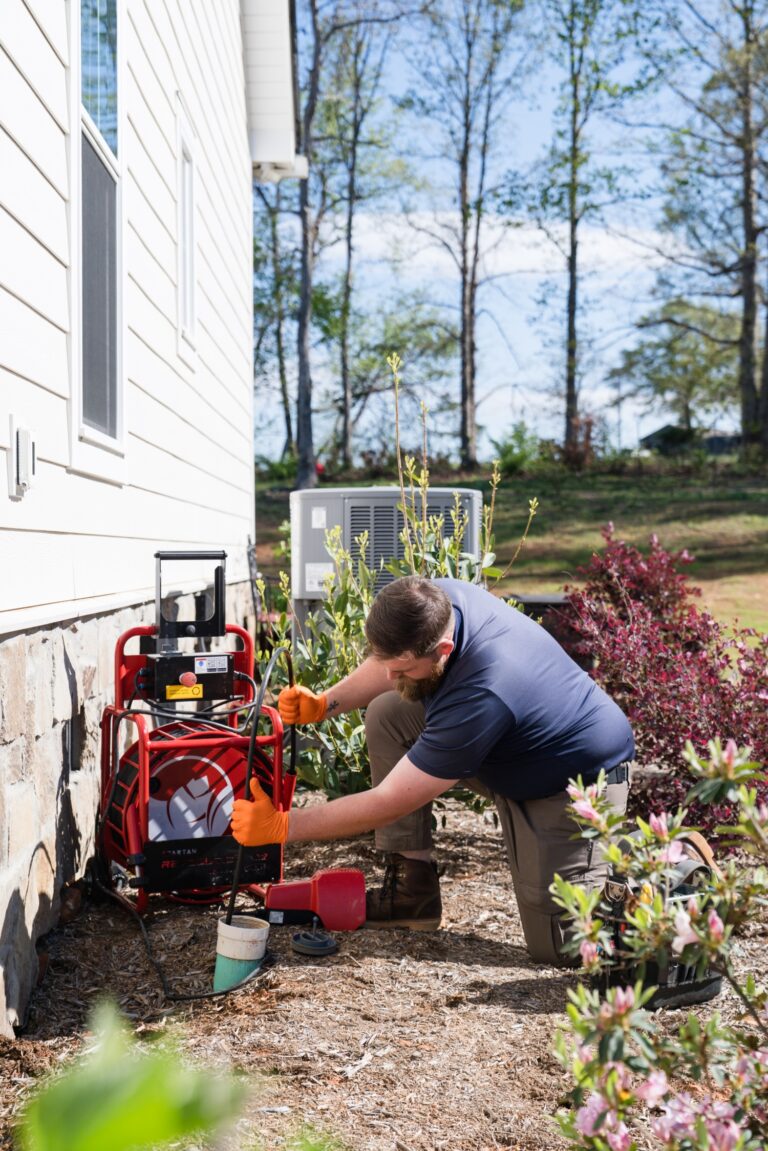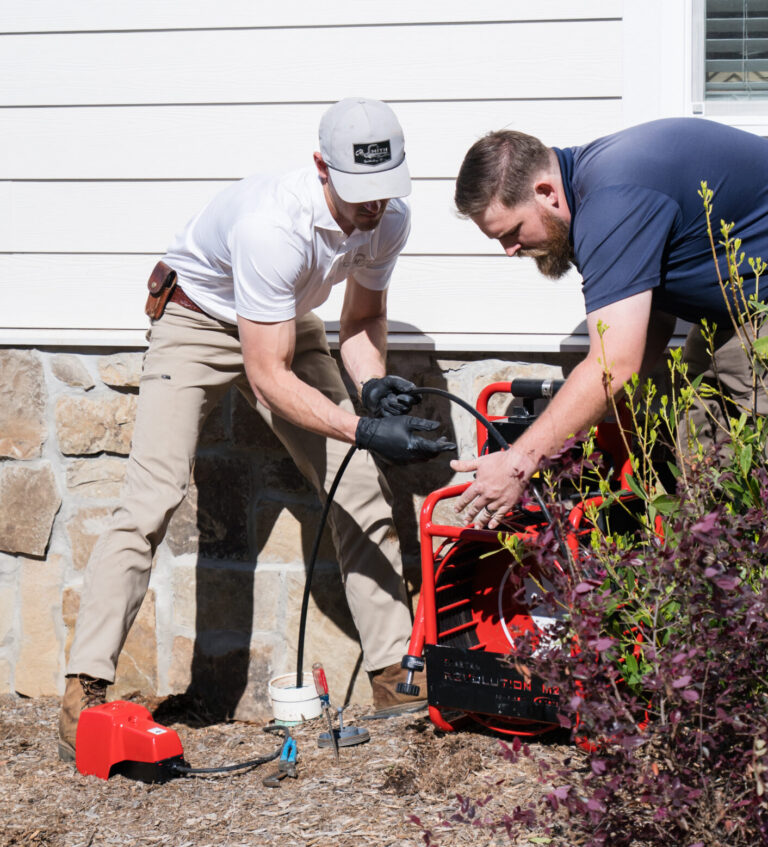

Trenchless sewer line repair in Spartanburg County can replace or rehabilitate a damaged underground line without opening one continuous trench across the property. That can matter when a sewer lateral runs beneath a driveway, mature landscaping, a patio, or another finished surface that would be expensive and disruptive to remove.
The word trenchless can also create the wrong expectation. These methods reduce excavation, but they do not make diagnosis optional, and they do not guarantee that every section of pipe can be repaired from the inside. A sewer that has collapsed, lost its slope, separated at a connection, or become inaccessible may still require targeted digging or conventional replacement.
The method has to match the defect. Cured-in-place pipe lining creates a new structural wall inside a usable host pipe, while pipe bursting breaks the old pipe outward and pulls a new line through the same path. A short defect may call for a localized repair instead of treating the entire run.
When several fixtures slow together, the first goal is not choosing a repair method. It is proving where the restriction or damage sits within the underground sewer line and whether the existing route can support a lasting repair.
In this article, you will learn about:
- A camera inspection decides whether trenchless work is even possible
- Pipe lining and pipe bursting solve different sewer failures
- Less digging does not mean no digging
- What trenchless sewer repair really costs in Spartanburg County
- The quote should prove the repair will last
Keep reading to understand which findings support a trenchless repair, which conditions rule it out, and how to compare the full project cost instead of focusing on one per-foot number.
A camera inspection decides whether trenchless work is even possible
A trenchless recommendation should begin with evidence from inside the sewer. The technician needs to see the pipe material, diameter, joints, connections, obstructions, deformation, standing water, and the exact location of each defect before selecting lining, bursting, spot repair, or excavation.
Camera footage is only useful when the lens can see the pipe wall clearly and the line has been located from the surface. A dirty pipe can hide cracks and offsets, while an unlocated camera can show damage without proving where the crew must work.
The line has to be cleaned before the footage means anything
Grease, roots, scale, paper, and settled debris can cover the defect that caused the backup. A camera pushed through that material may show only a dark channel or a temporary opening through the clog. It cannot reliably measure the pipe shape or confirm that the wall is strong enough to receive a liner.
The cleaning method should fit the pipe. Mechanical equipment may remove a concentrated obstruction, while water jetting can scour buildup along a longer section. Old, brittle, or already damaged pipe needs a controlled approach so the preparation process does not worsen a weak area.
When heavy buildup coats the pipe, the inspection should happen after the material is removed and the water has cleared. If the same clog returns after clearing, the second inspection should look for the structural reason debris keeps catching in the same place.
A useful preparation sequence includes:
- Confirm which fixtures feed the affected sewer branch.
- Identify a safe cleanout or other access point.
- Clear enough material to restore controlled flow.
- Clean the pipe wall so joints and defects are visible.
- Run the camera from a known reference point.
- Locate important defects from the surface.
- Record the full run, not only the worst-looking section.
The camera should move slowly enough to document the entire circumference of the line. Rushing past a joint or submerged section can miss the difference between a removable obstruction and a pipe that has shifted.
The cleaning result also needs to be judged before the camera findings are accepted. If roots remain at a joint, the footage may understate the size of the opening. If scale remains attached to cast iron, the measured diameter may not reflect the space available for a liner. Preparation is complete only when the pipe wall can be evaluated, not merely when water begins moving again.
A broader plumbing maintenance history also helps. Repeated backups at the same fixtures, prior root cutting, earlier spot repairs, and past excavation can explain why one section looks different from the rest.
Cracks can be lined, but a lost pipe shape changes the answer
CIPP lining depends on the existing sewer retaining a usable path and enough shape to receive the liner. The flexible tube is inserted through the host pipe, expanded against the wall, and cured into a new structural interior. It can bridge many cracks and seal defective joints, but it cannot pass through a section that no longer has an open route.
The EPA fact sheet describes CIPP as a resin-coated fabric tube that is inserted, expanded, and cured inside the existing pipeline. The same guidance notes that trenchless methods must be chosen according to system and site conditions rather than treated as interchangeable solutions.
A pipe that is oval, partially crushed, or heavily offset may still be repairable, but the degree of deformation matters. The liner follows the space available to it. If the remaining opening is too small or irregular, the finished result may restrict flow, create a weak point, or make insertion impossible.
The camera review should classify the condition of the host pipe:
- Open and round enough for liner insertion
- Cracked but still continuous
- Offset at one or more joints
- Deformed or partially crushed
- Fully collapsed
- Missing a section of wall
- Blocked by hardened material or an object
- Interrupted by a failed fitting or connection
A fully collapsed segment usually needs excavation before any trenchless work can continue. The crew may repair that point and line the remaining run, or the finding may shift the recommendation to pipe bursting or conventional replacement.
Do not assume that all moisture near the sewer route comes from wastewater. Unexplained moisture can also come from irrigation, groundwater, or a pressurized supply leak, so the sewer camera findings should be compared with what is happening above ground.
Slope, bellies, and failed connections can rule out a no-dig repair
A camera can show standing water, but it cannot calculate the full grade of the sewer by itself. Water remaining in one section may indicate a belly, a back-pitched line, a local obstruction, or an access point that was not flowing normally during the inspection. Locating and elevation measurements may be needed to confirm the cause.
Lining does not lift a sagging sewer or create a new slope. It conforms to the existing alignment. If the pipe has settled and wastewater is collecting in a low area, a smooth liner may improve the interior surface but leave the underlying grade problem in place.
The same limitation applies to a failed foundation exit, broken cleanout, or separated connection at the public main. Those points may need to be exposed so the new liner or replacement pipe can be terminated and connected correctly.
A belly also needs to be measured in context. A shallow film of water near the end of an inspection may result from temporary flow conditions, while a longer submerged section that remains at the same located distance can point to settlement. The contractor should explain how the low area was confirmed and whether it affects solids movement during normal use.
Connection failures deserve equal attention because the strongest liner cannot correct a loose fitting outside the lined segment. A repair that stops inches before a separated foundation adapter or damaged main connection can leave the original entry point for roots, soil, or groundwater untouched.
Conditions that deserve special attention include:
- Standing water that remains after the line is cleaned
- Repeated low spots at the same measured location
- A joint with a large vertical offset
- A connection that has pulled apart
- A branch opening that cannot be restored from inside
- A pipe route that changes diameter or material unexpectedly
- A defect directly beneath the foundation or another structure
The final recommendation may combine methods. A crew can excavate one failed connection, correct the grade locally, and use trenchless work for the rest of the line. The best project is the one that corrects every verified defect, not the one that avoids all digging at any cost.
If moisture or warm flooring suggests a separate pressurized-line problem, slab leak symptoms should be evaluated independently. A sewer repair should not be expected to correct a water-supply leak simply because both pipes are underground.
Pipe lining and pipe bursting solve different sewer failures
Trenchless sewer repair is a category, not one procedure. The two methods homeowners hear about most often, CIPP lining and pipe bursting, change the existing sewer in fundamentally different ways.
Lining rehabilitates the interior of the old pipe. Bursting replaces the old pipe along its route. The camera findings, pipe material, access, nearby utilities, desired diameter, and condition of the existing path determine which method is technically appropriate.
CIPP builds a new wall inside the existing sewer
CIPP begins with cleaning and measuring the existing line. A liner is prepared for the pipe length and diameter, saturated with resin, inserted through an access point, and expanded against the host pipe. The curing method depends on the system and may use controlled heat, steam, ultraviolet light, or ambient curing.
After curing, the liner forms a continuous interior surface. Openings and connections are restored as required, the ends are finished, and the line is inspected again. The result is often described as a pipe within the old pipe, but the quality depends on preparation, sizing, cure control, and termination details.
The EPA evaluated retrieved CIPP samples that had been in service for 5, 21, 23, and 25 years. Its retrospective pilot study reported that all four locations were in excellent condition, while also warning that a small pilot sample cannot represent every installation or every product.
A CIPP project should account for:
- The remaining shape of the host pipe
- The measured pipe diameter and repair length
- The resin and liner system selected for the wastewater exposure
- Cleaning and root removal before insertion
- Water or infiltration entering the pipe during installation
- Cure monitoring and documentation
- Reopening connections without damaging the liner
- A final camera inspection after the line returns to service
The reduced interior diameter is not automatically a flow problem. A smooth liner can reduce friction compared with a rough, deteriorated pipe, but the design still needs to confirm that the finished opening is adequate for the home.
CIPP is not a coating that hides the defect. It is a designed liner system that must be installed to the measured condition of the line. A generic liner recommendation without pipe dimensions, footage, and a defined cure process leaves too much unanswered.
Active groundwater or wastewater entering through a defect can complicate installation because the liner needs controlled contact with the host pipe during expansion and cure. The contractor should explain how infiltration will be managed and how cure conditions will be documented. The final inspection should confirm that the liner ends and any reopened connections are smooth, open, and free of resin obstruction.
Pipe bursting replaces the old line along the same route
Pipe bursting uses the old sewer as a guide rather than as a structural host. A bursting head is pulled through the existing pipe, breaking or splitting it outward while a new continuous pipe follows behind. Launch and receiving access points are usually required at the ends of the run.
The NASTT definition explains that the old pipe is fractured from within and displaced into the surrounding ground while a same-size or larger replacement pipe is drawn behind the tool. That ability to install a new pipe, and sometimes increase diameter, separates bursting from lining.
Pipe bursting can be attractive when the original line is too deteriorated to serve as a liner host but still provides a usable route. Brittle materials often break differently from ductile materials, so the equipment and head must match the existing pipe.
The planning process should verify:
- The material and diameter of the old sewer
- The length and route of the replacement
- The location of nearby utilities
- The size of the launch and receiving pits
- The pulling distance and equipment setup area
- The foundation exit and public connection details
- The new pipe material and connection method
- The restoration required at both access points
Bursting places outward force into the surrounding soil. Nearby gas, water, electric, communications, drainage, and irrigation lines must be located and assessed before work starts. The crew should map the full buried line route instead of treating the sewer as the only utility in the work zone.
Where new drain piping is required beyond the burst segment, the connection must preserve slope and provide serviceable access. Pulling a strong new pipe into place does not compensate for a poorly aligned tie-in at either end.
The replacement pipe is commonly assembled into a continuous length before the pull. That requires enough surface area to stage, join, and align the pipe without dragging it across damaging surfaces or forcing it through a sharp bend. The crew should also account for the pulling load so the new pipe and joints are not overstressed during installation.
Upsizing is possible in some conditions, but it is not automatic. Soil displacement, nearby utilities, the old pipe material, bends, and connection sizes can limit how much larger the new line can be. The proposal should state the finished diameter and explain why that size can be installed safely along the existing path.
A short damaged section may need a targeted repair instead
Not every sewer needs full-length lining or bursting. A pipe can remain serviceable across most of its run while one joint, fitting, root entry point, or crushed segment causes the recurring problem.
A localized internal sleeve or short liner may work when the defect is limited and the surrounding pipe remains strong. Targeted excavation may be better when the damaged point is shallow, easy to reach, or connected to a fitting that must be rebuilt by hand.
The cost comparison should include the entire scope. A short trench may be less expensive than mobilizing specialized equipment, while a targeted trenchless repair may preserve a driveway or finished area that would be costly to restore.
The transition at each end of a spot repair matters. A sleeve or short liner should not create a ledge that catches paper and solids, and an excavated replacement should be bedded and aligned so the new joints do not settle away from the older pipe. The crew also needs enough sound pipe on both sides to make the repair stable.
A localized repair is a poor choice when the camera shows several defects developing along the same run. Treating one opening while leaving nearby cracks, offsets, or root entry points can reduce the immediate backup without improving the condition of the line as a whole.
A spot-repair decision should answer:
- Is the defect truly isolated?
- Is the pipe upstream and downstream structurally sound?
- Will the repair create a smooth transition?
- Can roots or infiltration enter at another nearby joint?
- Is the failed section accessible from an existing cleanout?
- Would excavation provide a better connection or grade correction?
- Does the warranty cover only the repaired area or the full run?
A drain cleaning history can reveal whether the blockage repeatedly forms at one location or moves through the system. That pattern helps separate one damaged point from a line that is deteriorating across several sections.
Do not confuse sewer rehabilitation with whole-home repiping. Trenchless sewer work addresses the gravity line carrying wastewater away, while repiping usually addresses pressurized water-distribution piping inside or beneath the home.
Less digging does not mean no digging
The main practical advantage of trenchless work is reducing the length and area of excavation. That can preserve landscaping, hardscape, vehicle access, and daily use of the property, but equipment still needs a way to enter the sewer and connect the finished repair.
A realistic plan shows every disturbance before work begins. The homeowner should know where access pits, cleanouts, staging, spoil, hoses, curing equipment, and restoration will be located.
Access pits and cleanouts still control the job
CIPP may be inserted through a usable cleanout, a small excavation, or another approved access point. Pipe bursting generally needs a launch pit and a receiving pit large enough for the bursting head, pulling equipment, and replacement pipe.
The existing cleanout may be too small, poorly placed, damaged, or buried. Creating a new cleanout can improve both the current project and future maintenance, but it adds excavation, fittings, and restoration to the scope.
Access also affects how the replacement pipe is handled. Long fused pipe sections need room to be assembled and aligned, while lining equipment needs space for the liner, air or water controls, curing system, and safe work area.
Before the job starts, the plan should identify:
- Existing cleanouts and their condition
- The foundation exit point
- The public sewer or septic connection
- Proposed pit dimensions and locations
- Fences, walls, trees, sheds, and landscaping in the work path
- Driveway, patio, and sidewalk protection
- Equipment access from the street
- Areas that will need final grading or surface repair
A remodeling project can change access to the sewer later. If a patio, addition, or retaining wall is planned, the repair design should preserve cleanouts and avoid burying critical connections beneath new construction.
The same coordination matters when underground routes are planned early. A serviceable sewer alignment and accessible cleanouts reduce the difficulty of future inspection, cleaning, and repair.
Utility locating and site clearance happen before equipment arrives
Trenchless equipment follows an underground path that may pass close to other buried services. The crew must know the location of public utilities and investigate private lines that may not be included in utility marks.
The 2025 South Carolina 811 guidance requires notice three full business days before digging and describes a tolerance zone extending 24 inches on each side of a utility mark, plus half the facility diameter. It also explains that privately owned lines may not be marked by the utility operator.
Private irrigation, landscape lighting, propane, detached-building power, and water or sewer segments installed beyond the utility’s responsibility may require separate locating. Camera locating helps map the sewer, but it does not identify every other buried line.
Site preparation may include:
- Submit the locate request and confirm positive responses.
- Mark the proposed excavation areas in white.
- Review utility records and visible service entries.
- Locate the sewer camera from the surface.
- Identify private lines and irrigation zones.
- Protect structures, pavement, and landscaping near the setup area.
- Confirm that equipment can reach the pits without crossing unsafe ground.
A sewer project should also verify where sump pump discharge and yard drainage travel. Those systems can cross the work area even when they are not connected to the sanitary sewer.
Across CB Smith Plumbing’s Upstate service area, lot size, utility density, soil, and finished surfaces vary from one property to another. Those differences affect access and restoration more than the city name alone.
Public utility marks should be treated as the beginning of the investigation, not the complete map. The crew may need to expose, or daylight, a nearby utility by hand or vacuum excavation before operating a bursting head. That verification can add time, but it protects buried infrastructure that cannot be seen from the surface.
The equipment route above ground also needs review. A machine that can reach the yard only by crossing a septic component, soft soil, irrigation zone, or decorative paving may require mats, alternate staging, or a different access location.
Traditional excavation can still be the smarter repair
Open excavation is more disruptive, but it gives the crew direct access to the pipe, bedding, soil, fittings, and grade. That visibility can be valuable when the sewer has collapsed, shifted substantially, lost slope, or failed at a complex connection.
A shallow line beneath open lawn may be simpler and less expensive to excavate than to line or burst. Conventional replacement may also be the better choice when the route needs to change, the pipe needs a new elevation, or several fittings must be rebuilt.
The EPA notes that trenchless methods reduce restoration and disturbance compared with continuous dig-and-replace work, but its guidance also states that site constraints and system objectives must control method selection. Avoiding excavation is a benefit, not the only decision factor.
Excavation also allows the bedding beneath the pipe to be rebuilt. If settlement, washed-out soil, or poor support caused the original failure, placing a new pipe on a stable base may be more important than preserving the existing route. The trench can also provide the working room needed to correct elevation and inspect adjacent utilities.
Surface restoration should still be priced before the method is selected. Open lawn, removable pavers, reinforced concrete, mature trees, and structural slabs carry very different restoration consequences, so the disruptive option is not always the most expensive option after the full site is considered.
Traditional excavation deserves serious consideration when:
- The pipe has a severe belly or negative slope
- A section is fully collapsed
- The route must move around a structure
- The line changes direction through several failed fittings
- A foundation penetration needs reconstruction
- The public connection is damaged
- The pipe is shallow and easy to expose
- The soil or nearby utilities make bursting unsafe
- The host pipe cannot accept a liner
A properly designed drain route matters more than preserving the original route when that route has already failed. Correct slope, bedding, and connection geometry can justify excavation even when a trenchless option appears possible.
During major remodeling work, exposed areas may create a practical opportunity to replace or reroute the sewer before new finishes are installed. Timing the plumbing work with the broader project can reduce duplicated restoration.
What trenchless sewer repair really costs in Spartanburg County
There is no responsible flat price for trenchless sewer repair without an inspection. Two lines of the same length can have very different costs because one has a usable cleanout and open pipe, while the other needs root removal, access pits, utility conflict resolution, a rebuilt connection, and concrete restoration.
Per-foot pricing is useful only after the scope is defined. The estimate should separate the trenchless installation from the preparation and completion work that makes the new liner or pipe function as part of the home.
Per-foot prices are only one piece of the estimate
The linear footage affects material, installation time, and equipment use, but a short residential job still carries fixed mobilization and setup costs. That can make the effective price per foot higher than a long municipal project using the same general technology.
Diameter also matters. A larger pipe needs more liner material, resin, cleaning capacity, and curing energy. Pipe bursting may require a larger head, more pulling force, and more room to handle the replacement pipe.
Depth changes the cost of access excavation, trench protection, dewatering, and connection work. A six-foot-deep line near a foundation is not the same project as a shallow line in open lawn.
The base estimate should identify:
- Measured repair length
- Existing and finished pipe diameter
- Pipe depth at important points
- Number and size of access pits
- Cleaning and preparation method
- Liner or replacement-pipe specification
- Cure or pulling method
- Connection and cleanout work
- Final camera inspection
- Surface restoration responsibility
A homeowner should not multiply an online per-foot figure by the approximate yard length and treat the result as a quote. The fixed work around the pipe can represent a large share of a short project.
Some contractors establish a minimum project charge because the same specialized crew, camera, cleaning equipment, liner preparation, curing system, or pulling equipment must be mobilized for a 25-foot repair and a much longer run. The per-foot figure can therefore fall as footage increases even when the total price rises.
The route above the pipe can matter more than the length below it. Twenty feet beneath open lawn may carry less restoration risk than a shorter section beneath reinforced concrete, a retaining wall, or a finished room. A useful estimate connects each cost to a site condition the homeowner can see or verify.
When maintenance records show repeated cleaning, prior repairs, or chronic root entry, the contractor can plan preparation more accurately instead of discovering the full condition after mobilization.
Cleaning, camera work, reconnections, and restoration change the total
The trenchless installation cannot start until the line is ready. Heavy roots, grease, mineral scale, concrete, broken tools, or a collapsed section can add cleaning, cutting, or excavation before lining or bursting begins.
Camera inspection appears both before and after the repair for different reasons. The first inspection defines the scope, while the final inspection documents continuity, finished connections, and the condition of the completed run.
Connection work can include the foundation exit, cleanouts, branch fittings, the public sewer tie-in, and any exposed section needed to terminate the liner or new pipe. Restoration can include soil compaction, sod, planting beds, fencing, concrete, asphalt, pavers, or interior finishes.
Common cost layers include:
- Diagnostic visit and initial camera inspection
- Sewer locating and measurements
- Cleaning, root cutting, or descaling
- Utility locating and site preparation
- Access excavation or cleanout installation
- Liner installation or pipe bursting
- Connection and fitting reconstruction
- Testing and post-repair camera inspection
- Permit or inspection requirements
- Backfill, compaction, and surface restoration
A proposal that excludes restoration may appear cheaper than one that includes it. The homeowner should compare who is responsible for each surface and what standard of repair is included.
An urgent sewer backup can add temporary clearing or containment before the permanent project. Emergency work restores safe use, while the trenchless scope addresses the damaged line after the property is stabilized.
Preparation can also expose a condition that changes the method. A line expected to be lined may reveal a collapse after roots and debris are removed, while a pipe thought to need full replacement may prove suitable for a shorter repair. The estimate should explain how the price will change if the verified condition differs from the initial inspection.
Restoration allowances need the same detail. Replacing topsoil and sod is different from matching stamped concrete or rebuilding a masonry feature. The proposal should state whether restoration is complete, limited to rough backfill, or assigned to another contractor.
Public bid prices show why online ranges can mislead homeowners
Public bid tabs provide real numbers, but they describe large municipal projects rather than one residential sewer lateral. They are useful for showing how method, diameter, volume, and included line items change unit prices.
A 2025 Illinois CIPP bid tab, covering more than 1,800 feet of 8-inch lining, listed 6-inch bids from $68 to $125 per linear foot and 8-inch bids from $34 to $66 per linear foot. That project scale spreads setup and mobilization across far more footage than a short home lateral.
A separate 2025 Arkansas pipe-bursting bid tab listed 6-to-8-inch bursting at $110 to $120 per foot and service reconnections at $1,200 to $1,750 each. Mobilization, manhole setup, trench safety, restoration, and allowances appeared as separate line items.
A Texas pipe-bursting comparison priced several sewer segments at $84 per foot for bursting and $250 per foot for the open-cut alternate. The same bid also separated camera work, manhole replacement, connection restoration, site restoration, and bypass monitoring.
These figures do not create a Spartanburg County residential price list. They show why a credible estimate must state what is included and why two projects using the same method can produce very different totals.
The EPA’s latest needs survey reports $630.1 billion in national clean-water infrastructure needs, including $151.1 billion for conveyance-system repair and new conveyance. That scale reinforces why rehabilitation costs are tracked by condition, pipe size, location, and project type rather than one universal rate.
A written scope is the only useful way to compare quotes
A trenchless quote should describe the existing condition and the finished result. A one-line price for sewer lining or pipe bursting does not show whether the contractor included cleaning, access, reconnection, testing, or restoration.
The homeowner should receive the footage or still images supporting the recommendation. The proposal should identify the start and end points in measurable terms, not only say that the line will be repaired from the house to the street.
The estimate should also separate known work from allowances. A contractor may not know the exact condition of a buried connection until an access pit is opened, but the proposal can still state the assumed condition, the included allowance, and how additional work will be approved. That is more useful than an unexplained contingency added after excavation begins.
Quotes should be normalized before they are compared. If one includes cleaning, camera documentation, two access pits, reconnection, and concrete restoration while another includes only the liner, the totals are not competing prices for the same project. They are different scopes with different risks left to the homeowner.
A strong written scope explains:
- The verified defect and its location
- Why the proposed method fits that defect
- The exact footage included
- The existing and finished diameters
- The liner or pipe material
- Access points and expected excavation
- Cleaning and preparation requirements
- Connections and cleanouts included
- Testing and camera documentation
- Permit and inspection responsibility
- Restoration included or excluded
- Labor and material warranty terms
When you compare the written scope, the lowest total should not win automatically. A smaller scope can leave a failed connection, uncorrected belly, or damaged section outside the quoted footage.
CB Smith Plumbing’s residential plumbing services cover the connected drain and sewer system, which matters when the camera finds that the problem begins inside the home rather than in the exterior lateral.
The written scope should end with a clear change-order process. Homeowners should know who can authorize added work, how the price will be documented, and whether the sewer will remain usable while the decision is made. Clear boundaries protect both the property owner and the crew when underground conditions differ from the original evidence.
The quote should prove the repair will last
Trenchless work becomes a good value only when the completed sewer solves the verified defect and can be inspected afterward. The homeowner should be able to understand what changed, where connections were made, and how the crew confirmed the finished line.
Documentation matters because most of the work disappears underground. Camera footage, measurements, material information, cure or fusion records, and a clear warranty provide evidence that cannot be seen from the yard after restoration.
Ask to see the before-and-after camera footage
The pre-repair video establishes the starting condition. It should show the cleaned pipe, each significant defect, the measured distance from a known access point, and enough surrounding footage to confirm whether the problem is isolated or widespread.
The post-repair video should show a continuous interior, finished ends, open connections, and unobstructed flow. For lining, the camera should look for wrinkles, folds, incomplete cure, blocked openings, or poorly finished transitions. For bursting, it should verify the new pipe and each accessible connection.
The technician should explain any section that remains submerged or cannot be inspected. A video that moves too quickly, skips the endpoints, or shows only one direction can leave important details undocumented.
The final record should include:
- Date and property location
- Access point used for the inspection
- Direction of travel
- Distance markers or defect locations
- Start and end of the repaired segment
- Connections reopened or rebuilt
- Final flow test
- Notes about any unrepaired section
If wastewater is already entering the home, emergency sewer help may be needed before the full inspection can proceed safely. The immediate clearing and the permanent repair should still be documented as separate scopes.
Local Spartanburg homeowners should keep the final video with the invoice and warranty. That record can help with future maintenance, landscaping, remodeling, or a property sale.
The best footage includes a stable reference at the beginning and end. Distance counters can drift when the camera cable slips, so visible cleanouts, fittings, or surface-located points help confirm where the repair sits. A narrated explanation is useful, but the saved video should still make sense without relying on memory of the service visit.
Before-and-after files should be labeled clearly rather than delivered as anonymous clips. The homeowner should be able to identify which video shows the original defect, which shows preparation, and which confirms the completed repair.
Compare materials, dimensions, access, and warranty terms
A quote should name the liner or replacement pipe rather than describe it only as trenchless material. CIPP systems vary by tube construction, resin, design thickness, cure method, and installation procedure. Bursting projects vary by replacement pipe, joining method, diameter, and connection details.
The finished diameter matters because lining occupies space inside the old pipe, while bursting can replace the line at the same size or potentially increase it when conditions allow. The proposal should state the expected finished opening.
Warranty language should distinguish material coverage from workmanship and should explain what conditions are excluded. Root entry at an unrepaired connection, movement caused by a future excavation, or a defect outside the quoted footage may not be covered.
Review the following before signing:
- Product or pipe material
- Designed wall thickness or pipe dimension
- Finished internal diameter
- Repair start and end points
- Cure or joining method
- Connection materials
- Access-pit restoration
- Testing standard
- Labor warranty
- Material warranty
- Transferability to a future owner
- Exclusions and maintenance requirements
A new-construction plumbing plan should preserve access to the repaired sewer and avoid placing new structures over critical cleanouts or connections. The same principle applies when later additions change the yard.
If multiple supply pipes are failing, that work should be scoped separately from the sewer project. One underground repair should not be used to make unsupported claims about another piping system.
For CIPP, ask whether the quoted thickness is a design value for the measured pipe or only a product description. For bursting, ask how the replacement pipe will be joined and whether the joining method creates a continuous, leak-resistant pull section. Those answers reveal whether the proposal has been engineered for the property or copied from a generic service description.
The warranty should also state what maintenance is expected. If future root cutting, chemical use, excavation, or unapproved alterations can affect coverage, those conditions should be written plainly before the project begins.
A cheaper scope can cost more if it leaves the defect behind
The most expensive trenchless project is one that has to be repeated because the original scope stopped short of the actual failure. A quote may cover the visibly cracked pipe while excluding the separated connection that caused the recurring root entry.
A low price can also omit the preparation required for a sound installation. Lining over grease, scale, active infiltration, or loose material can compromise contact with the host pipe. Bursting without adequate utility investigation or access can create avoidable risk.
The comparison should focus on whether each proposal solves the same documented problem. Different totals may reflect different footage, methods, access points, restoration, or warranty rather than simple price differences.
Repeat mobilization is a major hidden cost. If a short liner ends before the damaged connection, the homeowner may pay again for cleaning, camera inspection, equipment setup, access, and restoration. A more complete initial scope can cost more today while reducing the chance of reopening the same area later.
Warranty value also depends on the repair boundary. Coverage for the liner does not help if the failure occurs at an excluded connection a few feet away. The proposal should show how the contractor evaluated the pipe immediately beyond both ends of the repair and why those termination points were selected.
Warning signs in a weak proposal include:
- No pre-repair camera footage
- No measured repair length
- No explanation of why lining or bursting fits
- No description of cleaning or preparation
- No finished diameter
- No plan for connections
- No post-repair camera inspection
- No restoration responsibility
- No written warranty
- Pressure to approve before the line is fully evaluated
Where routine inspections find problems early, a homeowner may have time to compare options before a complete backup forces an emergency decision. Planning is especially valuable when the sewer runs beneath expensive surfaces.
A property in Cherokee County or another nearby service area may have different utility ownership, permitting, and connection requirements. The contractor should verify the rules for the exact address rather than assuming every Upstate jurisdiction follows the same process.
Conclusion
Trenchless sewer repair can preserve much of a yard, driveway, or finished outdoor area, but the method must be selected from a cleaned and located camera inspection. CIPP lining depends on a usable host pipe, while pipe bursting replaces the old line and requires suitable access and clearance around the existing route.
Cost depends on more than footage. Preparation, depth, diameter, access pits, cleaning, connections, utility conflicts, permits, camera documentation, and restoration all shape the final total. Public per-foot prices can provide context, but they cannot replace a property-specific written scope.
The strongest proposal explains what failed, why the selected method fits, what will be repaired, what will remain, and how the finished sewer will be tested. That evidence matters more than whether the project is marketed as no-dig.
Contact CB Smith Plumbing to schedule a sewer line evaluation and determine whether lining, pipe bursting, targeted excavation, or conventional replacement is the right approach for your Spartanburg County property.