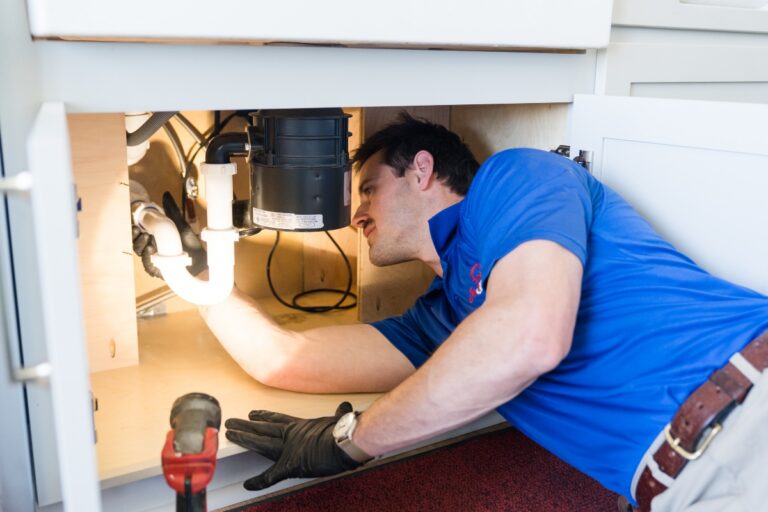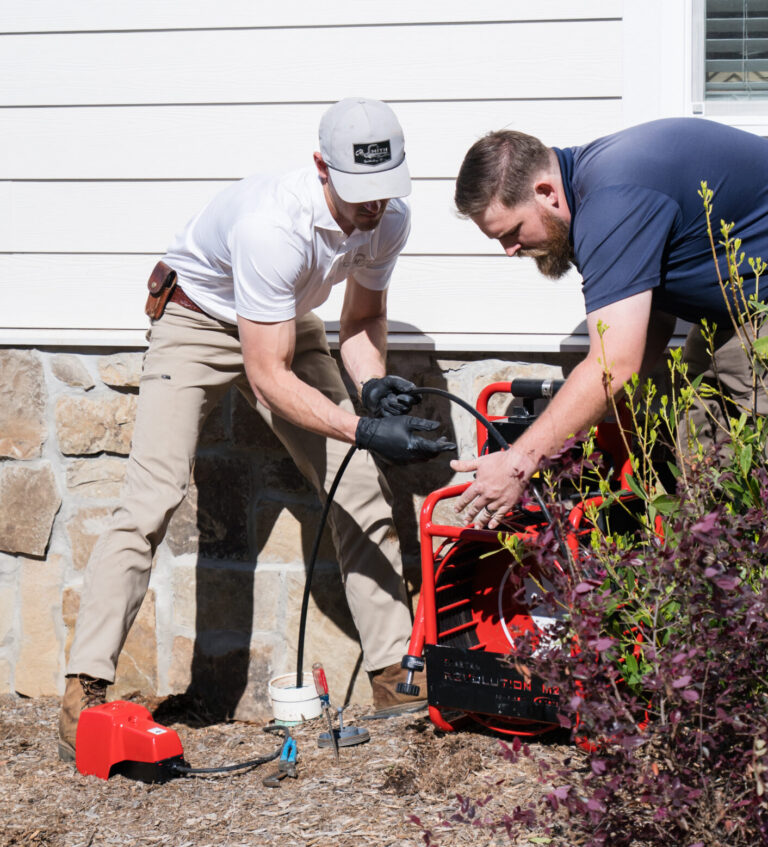
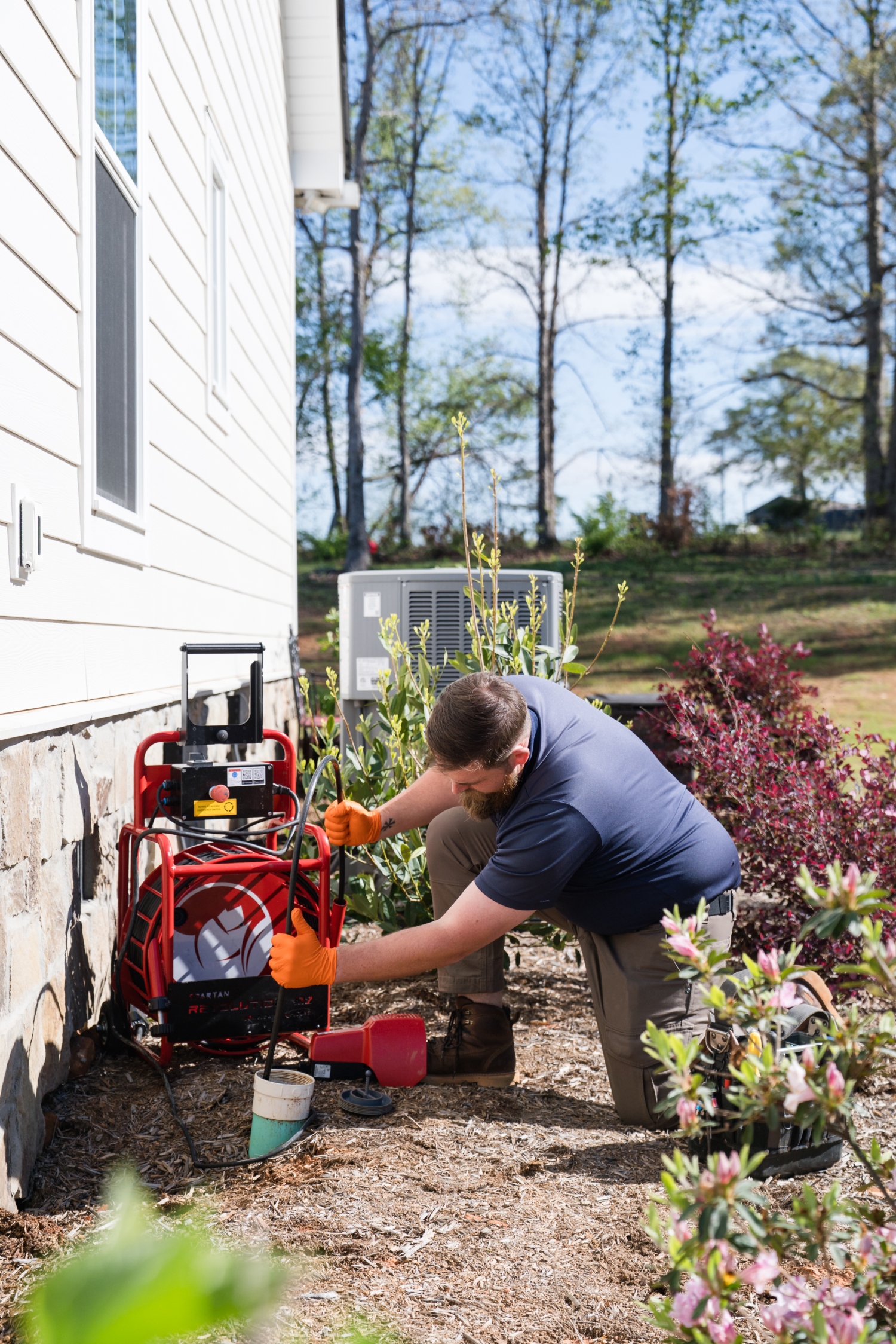

Homeowners across the Upstate tend to call CB Smith for the same reason. Something is backing up, draining slowly, or smelling wrong, and there is no way to know what is happening underground without digging. A drain camera inspection in Spartanburg County answers that question in minutes instead of leaving it to guesswork, because a small waterproof camera travels through the line and sends a live picture back to the technician holding the monitor.
For decades, diagnosing a drain problem meant relying on experience, a plunger, and a bit of luck. Snaking a line can clear a clog without ever revealing why the clog formed in the first place, which is exactly why the same backup often returns within a few months. A camera changes that equation by turning a hidden system into something a homeowner can actually watch on a screen, in real time, while the technician explains what they are seeing.
This article walks through what actually happens during a drain camera inspection, why jumping straight to a repair without one tends to cost Spartanburg County homeowners more, and which problems a camera reliably catches before they turn into a full backup. It also touches on how often you should clean your drains, since that habit affects what shows up on camera months later.
In this article, you will learn about:
- What actually happens during a drain camera inspection
- Why guessing at a drain problem costs more than an inspection
- The problems a camera catches before they turn into emergencies
- When Spartanburg County homeowners should schedule an inspection
Keep reading to see exactly what a camera catches that guesswork never will, and how much that difference can save you.
What actually happens during a drain camera inspection
A drain camera inspection follows a straightforward process, but the judgment behind it is anything but basic. A technician needs to recognize what is actually on the screen the moment the picture comes up, not just know how to feed cable into a pipe. Here is what the process looks like from the moment a technician arrives, whether it is for one of CB Smith’s residential plumbing services or a larger commercial account.
The camera and cable technicians use
The camera itself is a small, waterproof lens mounted on the end of a flexible fiberglass rod, built to push through bends and transitions that a rigid tool never could. It feeds a live picture back to a handheld or truck-mounted monitor as the technician advances it through the line, so the homeowner and the technician are looking at the same footage at the same time.
Most professional-grade setups also include a built-in sensor that tracks how far the camera has traveled and where problem areas sit relative to the surface. That distance reading matters later, because it tells a technician exactly where to dig if a repair is genuinely needed instead of opening up a yard based on a guess. For homes where the pipe itself needs replacing rather than repaired, that same distance data feeds directly into planning full repiping services instead of guessing at scope.
Walking the line from cleanout to connection
The camera typically enters through an existing cleanout, a capped access point built into the plumbing specifically for this kind of work. Where a cleanout is missing, which is common in older Spartanburg County homes, a technician can sometimes access the line through a roof vent or a removed toilet instead.
From there, the camera moves steadily toward the main line, and the technician watches for changes in pipe material, diameter, and slope along the way. A few things typically happen during this walk-through:
- The technician narrates what they see so the homeowner understands the condition of the line in real time
- Distance markers get logged at any point where buildup, damage, or a joint issue appears
- Footage gets saved so it can be compared against a future inspection if the same section acts up again
That documentation is part of what separates a real inspection from a quick look. Without it, there is nothing to reference the next time a slow drain shows up in the same part of the house.
Most residential inspections in Spartanburg County take well under an hour once the camera is in the line, since the goal is a clear diagnosis rather than an exhaustive survey of every foot of pipe. A technician who knows the property’s layout can usually get a complete picture on the first pass. That same visit is often when a homeowner asks a technician about general water quality, since the two conversations tend to happen back to back.
What shows up on the screen that matters
A trained eye is what actually makes a drain camera inspection worth paying for, since the footage itself only matters if someone knows how to read it. A crack that looks minor on screen can be structurally significant, while a dark patch that looks alarming might just be normal residue in an older clay line.
CB Smith technicians are trained to separate cosmetic wear from the kind of damage that predicts a future backup, which is why the same footage can lead two different companies to two very different recommendations. Getting that read right the first time is part of the standard CB Smith has held its technicians to since 1982. A technician already walking through pipe condition on screen is also a natural person to ask about tankless vs. traditional water heaters, since both decisions come down to trade-offs most homeowners have never had explained clearly.
Why guessing at a drain problem costs more than an inspection
Before cameras were standard equipment, homeowners and plumbers alike had to treat every drain problem the same way: clear it, hope it holds, and wait to see what happens next. That approach still shows up today when a company skips the diagnostic step, and it tends to cost more in the long run than the inspection itself would have. Part of knowing how to hire a plumber in Spartanburg is asking whether a diagnostic step happens at all before a repair gets recommended.
Repeat service calls add up fast
A snake or a jetter can clear most clogs on the first try, but clearing a clog and solving the underlying problem are two different things. If roots, a pipe belly, or a cracked joint caused the backup, the same symptom typically returns within a matter of months, and the homeowner pays for another service call to fix the same thing again.
Over a year or two, those repeat visits often add up to more than a single camera inspection would have cost upfront. A camera identifies the actual cause the first time, which means the fix that follows is aimed at the real problem instead of the symptom sitting on top of it. The same logic applies to something as routine as shower plumbing maintenance in Greenville, where a small leak ignored long enough eventually means replacing fixtures instead of a washer. That repeat-visit pattern shows up with water heater warning signs too, where a small issue ignored for months becomes a full replacement instead of a simple repair.
Digging in the wrong spot wastes a full day
Before cameras became standard, locating a break in a sewer line sometimes meant excavating an entire section of yard based on educated guesswork. That approach can mean tearing up landscaping, a driveway, or a section of foundation only to discover the actual damage sits several feet away from where the crew started digging.
A camera with distance tracking tells a technician the precise location of a problem before a single shovel goes into the ground. That precision is a large part of why CB Smith can quote sewer line repair with real confidence instead of a wide range that assumes the worst. This shows up just as often in rural stretches of Union, where long distances between fixtures make excavation guesswork even more expensive.
Misdiagnosed problems come back worse
A drain that gets treated as a simple clog when it is actually a collapsing or badly corroded pipe will eventually fail again, usually at a worse moment and a higher cost. Homes that need repiping because of long-term corrosion often show early warning signs on camera years before the pipe actually fails, and catching that early is what keeps a manageable repair from turning into an emergency.
The frustrating part is that a misdiagnosis is rarely obvious right away. A repair can look successful for weeks or even months before the underlying problem resurfaces, by which point the original cause has usually gotten worse instead of staying the same. A misdiagnosis carries far higher stakes with a gas line, which is why anyone who thinks they suspect a gas leak should treat it as an emergency rather than something to monitor.
A handful of costs tend to stack up when a problem gets misdiagnosed instead of properly inspected:
- The original service call to clear the symptom
- A second call within months when the same symptom returns
- Property damage from a backup that happens before the real cause gets found
- A larger, more invasive repair once the underlying issue can no longer be ignored
Each of those costs is avoidable with an accurate diagnosis up front, which is exactly what a camera inspection is built to provide.
The problems a camera catches before they turn into emergencies
Most of the value in a drain camera inspection comes from what it catches before a homeowner ever notices a symptom. The following issues are the ones CB Smith technicians see most often across Spartanburg County’s mix of older neighborhoods and newer subdivisions.
Root intrusion working its way into the line
Tree roots are drawn to the moisture and nutrients inside a sewer line, and they can work their way in through the smallest crack or loose joint. Roots are responsible for more than half of all reported sewer blockages, according to U.S. Forest Service research, which makes root intrusion one of the most common findings on camera across older, tree-lined streets.
Homes in neighborhoods like Boiling Springs, Duncan, and Landrum, where mature trees often sit close to the sewer line, tend to see this more than newer subdivisions with modern PVC piping. Once roots are visible on camera, a technician can recommend the right fix, whether that is jetting the roots out, a spot repair, or a longer-term solution, based on how far the intrusion has spread.
Routine residential plumbing maintenance in Boiling Springs and similar tree-lined neighborhoods often catches root activity long before it turns into a backup. A few warning signs tend to show up above ground before the problem ever reaches the point of a full clog:
- Gurgling sounds from drains or toilets that have nothing to do with recent use
- Slow drainage in the lowest fixtures of the house first, before anywhere else
- Unusually lush or damp patches of grass tracing the path of the sewer line
- Recurring clogs in the same drain despite regular cleaning
None of these signs guarantee root intrusion on their own, but together they are usually enough reason to schedule a camera before the yard ends up needing repair too.
Bellied or sagging pipe sections
A pipe belly happens when a section of line settles or sinks below its original slope, usually because of soil movement or poor original installation. Waste and water start collecting in that low spot instead of flowing through, which creates a chronic slow drain or recurring clog that snaking alone will never fully resolve.
This is one of the harder problems to diagnose without a camera, because the symptoms mimic a simple clog almost perfectly. Seeing the actual dip in the pipe on screen is usually the only way to confirm a belly exists and to measure how severe it is before recommending a repair. Homes in Roebuck with basements deal with a similar diagnostic challenge around sump pump maintenance, since a failing pump and a failing drain line can produce the exact same puddle. Homeowners in Fountain Inn dealing with a chronic slow drain often assume it is just old pipe, when a belly is just as likely the real cause.
Cracks, corrosion, and pipe material breakdown
Older Spartanburg County homes often still run on cast iron or clay drain lines, both of which break down differently than modern PVC over the decades. Cast iron corrodes from the inside out, gradually narrowing the usable space inside the pipe, while clay tends to crack and shift as the ground around it settles or as roots search for moisture.
Nationally, the EPA estimates at least 23,000 to 75,000 sanitary sewer overflows occur every year, and closer to home, South Carolina has averaged almost 600 reported sewer overflows a year over the past decade, according to the state’s Department of Environmental Services. A camera inspection is often the first real look a homeowner gets at how much wear an older line has actually taken on. A few materials show up again and again in Spartanburg County’s older housing stock:
- Cast iron, common in homes built before the 1970s, prone to internal corrosion
- Clay, common in even older construction, prone to cracking and root intrusion
- Orangeburg, a wood-pulp pipe used briefly decades ago that tends to deform under soil pressure
- PVC, the modern standard, far more resistant to corrosion and root intrusion than older materials
Knowing which material is actually in the ground changes the entire recommendation, and that is something a camera confirms far more reliably than pipe age alone.
Homeowners noticing slab leak warning signs alongside a slow drain should treat both as related evidence of an aging system rather than two separate problems. Either issue on its own is worth a look, but the combination usually means the whole system deserves a closer inspection.
Offset joints and old connections
Every place two sections of pipe meet is a potential weak point, and older installations were not always sealed to modern standards. An offset joint happens when two connected sections shift out of alignment, leaving a gap where waste, grease, and debris can catch and slowly build into a blockage.
These joints are easy to miss without a camera, because the pipe on either side of the offset can look perfectly normal from the surface. Once a technician spots one on screen, they can flag it as a spot repair candidate long before it becomes the kind of blockage that leads to a late-night emergency plumber call in Greenville or anywhere else in the service area. The same kind of connection issue turns up often in Mauldin, where older and newer construction sit close together and two different eras of pipe sometimes meet at a single joint.
When Spartanburg County homeowners should schedule an inspection
A drain camera inspection is not something most homeowners need every year, but there are specific situations where scheduling one ahead of time saves real money and real stress compared to waiting for a symptom to show up. It is also a good moment to ask about anything else on the to-do list, whether that is tankless water heater installation or a fixture that has been acting up for a while.
Buying or selling a home with older plumbing
A home inspection typically does not include a look inside the sewer line, which means a buyer can move into a house with a hidden problem that only becomes obvious a few months later. This is especially common across the older sections of Spartanburg and Gaffney, where original clay or cast iron pipe is still in the ground decades after installation.
The same risk shows up near the Cherokee County line, where rural properties often sit on plumbing that has never been inspected since the original build.
A camera inspection before closing gives both sides real information instead of an assumption. For sellers, it can also head off a buyer’s request for a price reduction over a plumbing issue that a quick fix could have resolved beforehand.
Clogs that keep coming back
A single clog is usually nothing to worry about. A clog that returns every few months in the same drain, sink, or tub is a different story, and it almost always points to something a camera can confirm that a plunger never will. That pattern often shows up alongside the hidden leak detection signs homeowners in Inman have learned to watch for, since both point to a system that is no longer draining the way it should.
Before assuming the fix is another round of snaking, it is worth asking a technician to run a camera through the line first. The answer might be as simple as a grease buildup near a kitchen connection, or it might point to a pipe belly, a partial collapse, or root intrusion that needs a different kind of repair entirely. Homeowners who solve a recurring clog often ask about a water softener installation in the same visit, since hard water buildup can look a lot like a mechanical clog on camera.
Before a remodel, addition, or landscaping project
Any project that involves digging, adding a bathroom, or connecting new fixtures to an existing line is a good reason to inspect that line first. The new construction plumbing tips CB Smith shares with homeowners in Lyman apply just as much to a major remodel as they do to a brand-new build, since both situations put new demand on pipe that may not have been sized or maintained for it.
Contractors are focused on their own scope of work, and a plumbing inspection is rarely part of that scope unless someone specifically asks for one. That makes it the homeowner’s responsibility to schedule the check before a project moves too far along to fix anything cheaply.
A few situations tend to justify scheduling an inspection before work begins:
- Adding a bathroom, laundry room, or kitchen island with new drain connections
- Landscaping or hardscaping work planned near a known sewer line path
- A home renovation involving a slab that will be poured or repoured
- Any of the remodel plumbing ideas homeowners in Mayo or Woodruff are considering for a property with unknown pipe history
Catching a weak section of pipe before a contractor pours concrete over it, or plants a tree directly above it, is far cheaper than fixing the same problem afterward. It also avoids the awkward conversation of asking a contractor to tear out finished work because a pipe problem surfaced after the fact.
Conclusion
A drain camera inspection turns a guessing game into a diagnosis, and that difference is worth more than the inspection itself usually costs. Instead of clearing a symptom and hoping it does not come back, a homeowner gets a real answer about what is happening inside their pipes and what it will actually take to fix it.
That kind of clarity matters everywhere CB Smith works, from long-established neighborhoods in Spartanburg and Gaffney to newer construction out toward Duncan and Boiling Springs. Older pipe, mature trees, and decades of settling ground all show up differently on camera, and reading that footage correctly is what keeps a small problem from becoming an expensive one.
If a drain in your home keeps backing up, or you simply want to know what condition your sewer line is really in, a camera inspection is the fastest way to find out. CB Smith Plumbing has been part of the Upstate community since 1982, and a real technician is ready to walk you through exactly what the camera finds.
Call CB Smith Plumbing at (864) 574-4275, or request an appointment online to schedule your drain camera inspection today.